Active Portfolio Management Grinold Kahn Pdf File
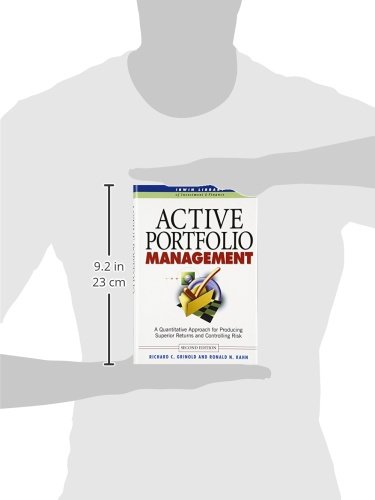

This unusual book is not intended chiefly as a textbook for investment courses. The book's principal target audience is quantitatively inclined investment management professionals with some masters-level knowledge of finance. However, it could make an excellent textbook for a second-year MBA course in quantitative portfolio management; the authors mention this as a possible use of the book. Be warned: anyone teaching a course based on this book would need to make a substantial commitment to mastering and expositing a large body of unfamiliar, analytical material. The payoff would be a class full of students who could not complain that the course was not practically relevant.
Alternatively, the book could play a valuable supporting role in an investments course as optional outside reading. Students query the usefulness of modern portfolio theory in business applications.
Accuracy of information, 15–16. Active Portfolio Management (Grinold and. Adverse selection, 247, 267, 270. Adverse selection bias, 95, 122. Financial transaction tax (FTT), 297–298. FIX (Financial Information eXchange) protocol, 129–130. Flash Crash, 5, 238, 247, 288, 289, 294–296. Flat files, 144. Please refer to the disclaimer at the end of this document. Manager's quantifiable expected returns, or alphas, in connection with constructing portfolios that maximize. Grinold, The Journal of Portfolio Management, Summer 1994, or 'Active Portfolio Management', Richard C. Grinold and Ronald N. Large number of stocks” (Grinold and Kahn 1995, p. But should that be the goal of active managers – take their modest amount of skill and apply it far and wide with the belief that on average this should produce superior portfolios? While greater manager skill and broader investment opportunities are not mutually.
In this book the authors nearly describe how. Knoppix Boot Only Isosceles.
Sample Soapui Pro Project Xml Downloader. IntesaBci S. Download Blizzard Ngage Installer. p.A. Harvey Fuqua School of Business, Duke University, Durham, NC USA National Bureau of Economic Research, Cambridge, MA USA September 10-13, 2001 Course Description This course delivers the theory and the quantitative tools that are necessary for advanced application of the principals of global asset management. The focus of the course is on strategic and tactical rather than passive asset management. To this end, we develop the fundamental concepts of asset valuation in a world with time-varying risk and risk premiums. We also focus on the most recent advances quantitative forecasting methods. The course builds on three asset allocation concepts.
We begin with the strategic asset allocation decision. This is a long-term posturing. Next we discuss tactical asset allocation. This is short term changes in investment weights that capture targets of opportunities (sometimes called market timing).
Finally, we focus on the bottom up decision. One unique feature of the course is that students are shown how to put a portfolio together from individual stocks (stock picking). Video Clips I have shot a series of short clips for both of my courses. NOTE: ALL VIDEO CLIPS ARE SERVED BY DUKE UNIVERSITY SERVERS. Webcast There is a webcast of many of the topics in this course. To view on demand, click here.